
Cycling is more than just a pastime in Marietta; for many, it is a daily commute, a fitness regimen, and a way to connect with our community. From the dedicated riders tackling the miles on the Silver Comet Trail to commuters navigating Roswell Road or students riding near Kennesaw State University, bicycles are a fixture of Cobb County life.
However, sharing the road with motor vehicles presents serious, often life-threatening risks. As traffic density increases around major arteries like Cobb Parkway and the Marietta Loop, the margin for error shrinks. When a 3,000-pound vehicle collides with a 20-pound bicycle, the results are almost always catastrophic for the rider.
For victims and their families, the aftermath of a bicycle accident is a blur of pain, confusion, and mounting medical questions. Insurance companies often complicate matters by attempting to shift blame onto the cyclist. Understanding Bicycle Accident Claims and Legal Rights is not just about filing paperwork it is about securing the resources you need to rebuild your life.
Cyclist Rights and Responsibilities Under Georgia Law
A common misconception among drivers and even some police officers is that bicycles are “toys” or obstructions that do not belong on the road. This is legally incorrect. Under Georgia law (O.C.G.A. Title 40), bicycles are classified as “vehicles.” This classification grants cyclists the same general rights and duties as drivers of motor vehicles, with specific statutes designed to protect them.
The “3-Foot Rule” (O.C.G.A. § 40-6-56)
One of the most critical protections for cyclists is the Georgia Safe Bicycling to School Act, commonly known as the 3-Foot Rule. This statute explicitly requires that the operator of a motor vehicle, when overtaking a bicycle proceeding in the same direction, must leave a “safe distance” between the vehicle and the bicycle.
The law defines this safe distance as at least three feet.
- Drivers must make a lane change into a lane not adjacent to the bicycle if possible.
- If a lane change is impossible, the driver must reduce their speed to at least ten miles per hour below the posted speed limit (or 25 mph, whichever is higher) and pass with at least three feet of clearance.
Violating this rule constitutes a traffic offense and serves as strong evidence of negligence in a personal injury claim.
Lane Positioning: “Taking the Lane”
Many drivers believe cyclists must hug the curb at all times. However, O.C.G.A. § 40-6-294 states that while cyclists should generally ride as near to the right side of the roadway as practicable, there are crucial exceptions where a cyclist is legally entitled to take the full lane:
- Turning Left: When preparing for a left turn.
- Avoiding Hazards: To avoid surface debris, potholes, drain grates, or parked cars (to avoid “dooring”).
- Narrow Lanes: If the lane is too narrow to safely share side-by-side with a motor vehicle (which applies to many roads in historic Marietta).
- Passing: When overtaking another vehicle.
Sidewalk Riding
In Marietta, as in the rest of Georgia, it is generally illegal for anyone over the age of 12 to ride a bicycle on a sidewalk unless a local ordinance specifically allows it. Adult cyclists belong on the road. Riding on the sidewalk can actually increase accident risks at intersections, as drivers turning out of driveways do not expect fast-moving traffic on the pavement.
Equipment Requirements
To be road-legal, especially at night, cyclists must adhere to equipment standards (O.C.G.A. § 40-6-296):
- Lights: A white light on the front visible from 300 feet and a red light or reflector on the rear visible from 300 feet are mandatory for night riding.
- Brakes: The bike must have a brake capable of making the braked wheels skid on dry pavement.
- Helmets: Georgia law requires helmets for riders under the age of 16. While adults are not legally required to wear them, we strongly advise every rider to wear a helmet. In a legal claim, defense attorneys may try to argue that an unhelmeted rider failed to mitigate their damages, though this argument is legally complex and often contested.
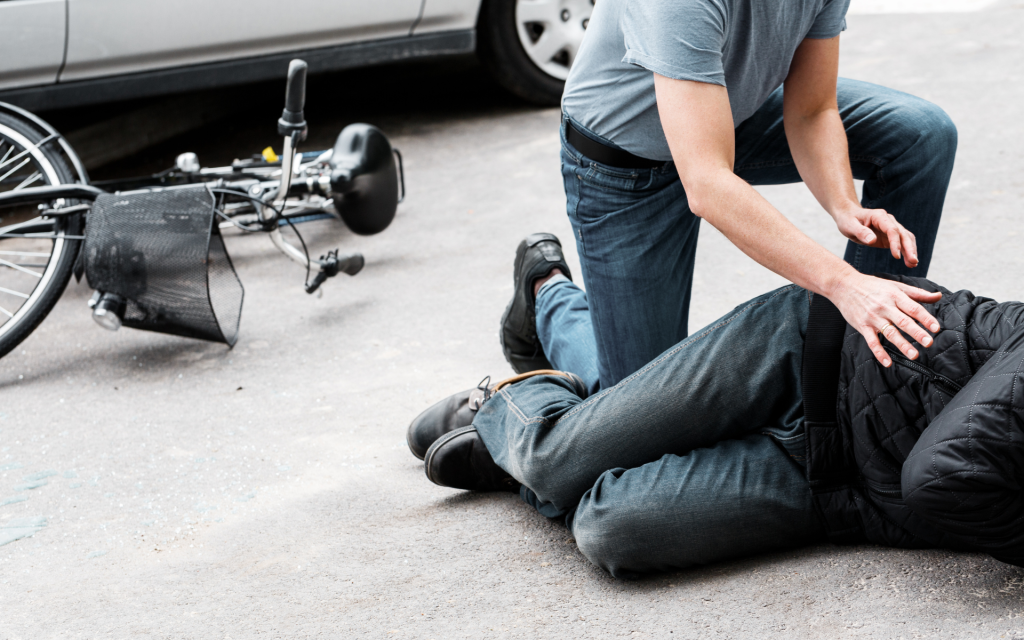
Common Causes of Bicycle Accidents in Cobb County
Proving liability in a bike crash requires identifying exactly how the driver was negligent. In our practice at Connelly Law, we frequently see the same dangerous patterns causing injuries:
1. The “Right Hook”
This occurs when a motorist passes a cyclist on the left and then immediately turns right directly across the cyclist’s path. The driver often misjudges the cyclist’s speed or simply fails to check their blind spot. This cuts the rider off, often causing them to slam into the side of the car.
2. The “Left Cross”
A driver traveling in the opposite direction turns left at an intersection and strikes a cyclist proceeding straight through. Drivers are conditioned to look for other large cars or trucks; they often look “right through” a cyclist, leading to a high-speed collision. Dangerous intersections in Marietta, such as those along Cobb Parkway or Roswell Road, are frequent sites for these crashes.
3. “Dooring” incidents
When a driver in a parallel-parked car opens their door without checking for oncoming traffic, a cyclist may have no time to stop. Impact with a car door acts like a solid wall, launching the rider over the handlebars.
4. Distracted Driving
With the rise of smartphones, distracted driving has become a plague on our roads. A driver glancing at a text message or GPS for just two seconds can drift into a bike lane or shoulder. For a car, this drift is a minor correction; for a cyclist, it is often fatal.
Negligence and Comparative Fault
After an accident, the driver’s insurance company will almost immediately begin an investigation. Their goal is often to find a way to blame the cyclist. They may argue you were riding too far to the left, that you were hard to see, or that you were distracted.
Negligence Per Se
If the driver violated a specific traffic law—such as speeding, driving under the influence (DUI), or violating the 3-Foot Rule—this is considered “negligence per se.” It means the act itself is deemed negligent by law, making it significantly easier to prove liability.
Modified Comparative Negligence
Georgia follows a modified comparative negligence rule (O.C.G.A. § 51-12-33). This legal doctrine acknowledges that sometimes both parties share some blame.
- The 50% Bar: You can recover compensation as long as you are less than 50% at fault for the accident. If you are found to be 50% or more responsible, you receive nothing.
- Reduced Damages: If you are found partially at fault (e.g., 20%), your total compensation is reduced by that percentage. For instance, if a jury awards you damages but finds you were 20% at fault for having a dim taillight, you would receive 80% of the award.
Insurance adjusters know this rule well. They will try to manipulate your statement to pin at least 50% of the blame on you to avoid paying anything. This is why you should never give a recorded statement to the at-fault driver’s insurance company without an attorney present.
Compensation for Serious Injuries
Bicycle accidents rarely result in minor “fender benders.” The cyclist is completely exposed. Common injuries we see include:
- Traumatic Brain Injuries (TBIs): Even with a helmet, the force of impact can cause concussions or severe brain bleeds.
- Road Rash: Often dismissed as minor, deep road rash can require skin grafts and carries a high risk of infection.
- Fractures: Broken clavicles (collarbones), wrists, and hips are common as riders instinctively put their arms out to break a fall.
- Spinal Cord Injuries: These can lead to partial or total paralysis.
A successful legal claim must account for the full scope of these damages. This includes:
- Medical Expenses: Current bills (ER, surgery, ambulance) and future costs (rehabilitation, home modifications, long-term care).
- Lost Wages: Income lost while you are in the hospital or recovering at home.
- Loss of Earning Capacity: If your injuries prevent you from returning to your previous career or force you to take a lower-paying job.
- Pain and Suffering: Non-economic damages for the physical agony, emotional trauma, PTSD, and loss of enjoyment of life (e.g., being unable to ride again or play with your children).
What If the Driver Can’t Pay?
This is one of the most critical aspects of bicycle accident claims that many people overlook. In Georgia, the minimum liability insurance required for drivers is often insufficient to cover a serious hospital stay, let alone surgery and rehab.
Uninsured/Underinsured Motorist (UM/UIM) Coverage
If the at-fault driver has no insurance (Uninsured) or low limits that don’t cover your bills (Underinsured), you may be able to file a claim against your own auto insurance policy.
- Crucial Protection: Most cyclists do not realize that their own car insurance UM/UIM policy typically follows them, even when they are riding a bike or walking as a pedestrian.
- Stacking: Depending on how your policy is written, you may be able to “stack” coverage to reach a sufficient amount.
Medical Payments (MedPay)
You may also have “MedPay” coverage on your auto policy. This creates a fund available to pay medical bills immediately, regardless of who was at fault for the crash.
What to Do Immediately After a Bike Crash
The moments following a collision are chaotic, but the steps you take can make or break your future legal case.
- Call 911 Immediately: Even if you think you are “okay,” adrenaline can mask serious injuries. You need a police report to document the incident. Ensure the officer gets your version of the story; often, they only hear the driver’s side if the cyclist is being treated by EMTs.
- Seek Medical Attention: Go to the emergency room or urgent care. A delay in treatment gives the insurance company leverage to argue your injuries were not caused by the crash.
- Preserve Evidence—Do Not Fix Your Bike: Your bicycle, helmet, and torn clothing are physical evidence. Do not repair the bike or wash your clothes. Keep the helmet exactly as it is (it often shows the point of impact). Take photos of the damage.
- Gather Witness Info: Eyewitnesses are often the key to winning “he-said, she-said” disputes. Get names and phone numbers before they leave the scene.
- Document the Scene: If you are able, take photos of the car, the intersection, skid marks, and road conditions.
Statute of Limitations
In Georgia, you generally have two years from the date of the accident to file a personal injury lawsuit. While this sounds like a long time, building a case takes months. Evidence disappears—surveillance footage is overwritten, skid marks fade, and witnesses move away.
Special Note for Government Vehicles: If you were hit by a City of Marietta truck, a Cobb County vehicle, or a designated public transit bus, the deadline to file an “ante litem notice” (a formal notice of claim) can be as short as six months to one year. Missing this administrative deadline can kill your case instantly.
Get Help from a Marietta Bicycle Accident Lawyer
Cyclists deserve to be safe on our roads. When a negligent driver shatters that safety, you face an uphill battle against insurance giants who view you as a liability statistic.
Connelly Law stands ready to advocate for you. We understand the specific dynamics of bicycle crashes and the bias riders often face. We know how to uncover all available insurance policies—including your own—to ensure you are not left paying for someone else’s mistake.
If you or a family member has been hurt in a bicycle accident in Marietta, Smyrna, or anywhere in Cobb County, do not wait. Contact us today for a consultation. Let us handle the legal fight so you can focus on the most important ride of all—your road to recovery.